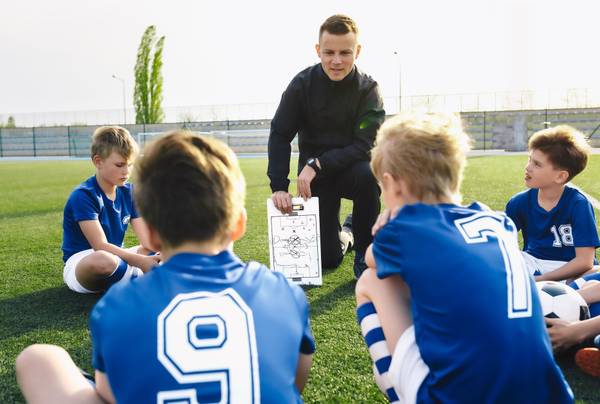

Every week in every game coaches deliver instructions, encouragement and feedback to our young players. Yet whilst our training drills are endlessly scrutinised and analysed, the actual words coaches use are sometimes treated as background noise rather than the powerful learning tools they really are. Modern coaching would suggest that the language coaches choose, the tone they adopt and the timing of their communication can influence a player’s development more dramatically than any specific drill or tactic. This understanding how the brain processes information during competitive situations has transformed our approach to coaching communication, moving us beyond the dated models of screamed commands from the side towards more sophisticated dialogue that accelerates learning and builds genuine confidence.
The traditional image of the grassroots football coach, bellowing their instructions from the touchline reflects a bygone era when communication was viewed as simple information transfer.
Players were expected to absorb instructions naturally and execute them without question, creating an environment where compliance mattered more than understanding. This approach seemed logical enough at the time, experienced coaches possessed knowledge that inexperienced players needed, so an efficient passing of that knowledge should produce improved performance. This thinking was undone by decades of research in cognitive psychology and educational science which revealed fundamental flaws in this assumption, showing that learning is far more complex than passive information absorption, particularly in dynamic environments where a split second decision can determine success or failure.
The human brain, especially the still developing adolescent brain, operates under significant constraints when processing information during competitive activities. Young footballers must simultaneously manage execution of their technical skills, tactical awareness, opponent positioning and teammate’s movement whilst making rapid decisions under sometimes intense pressure.
Cognitive load theory explains that we possess limited mental capacity for processing information, and when this capacity becomes overwhelmed, performance deteriorates rapidly regardless of underlying skill levels. Traditional coaching approaches sometimes exacerbated this problem by adding layers of information onto already overloaded cognitive systems, creating confusion rather than clarity at precisely the moment when players needed support most.
Modern coaching communication strategies work within the boundaries of these cognitive constraints rather than against them, recognising that effective instruction must account for how the brain actually processes information under pressure. Instead of delivering lengthy tactical explanations during high intensity moments, modern coaches use carefully chosen cues that provide clear direction without overwhelming mental capacity. A defender receiving the simple instruction "inside" during a crucial one on one situation can process and execute this guidance more effectively than someone trying to recall a complex defensive positioning lecture delivered earlier in the session. The most effective coaches often develop libraries of concise, memorable phrases that distil complex concepts into actionable guidance accessible even when stress hormones reduce attention and cognitive flexibility.
The framing of instructions represents perhaps the most significant advancement in coaching communication science. Traditional approaches frequently relied on prohibition based language, telling players what not to do rather than providing positive direction e.g. "don't lose it," "don't play there," or "don't let them turn." Neuroscientific research has revealed an interesting phenomenon called ironic processing, where the brain must first imagine the forbidden action before attempting to inhibit it. This means that instructing a young goalkeeper "don't go to ground too early" actually increases the likelihood of premature diving because the prohibition plants that exact image in their mind during decision making moments. One of the most famous examples of this was came years ago in the famous documentary on beleaguered England Manager Graham Taylor and his post match talk to his players which consisted of him repeating the phrase, “We must not lose in Norway, we must not lose in Norway.” The documentary immediately cut to the 2-0 defeat in Norway.
Progressive coaches now frame guidance more positively, providing clear mental blueprints for success: "stay patient," "be brave with it," or "set yourself," giving players vivid pictures of desired actions rather than confusing prohibitions.
The evolution from authoritarian to collaborative communication styles reflects a deeper understanding of motivation and learning psychology. Research consistently demonstrates that players who understand the reasoning behind tactical decisions make superior in game choices compared to those who simply follow predetermined instructions. When coaches explain not just what to do but why specific actions are effective, they develop what sports scientists term "game intelligence" the fabled ability to read developing situations, anticipate opponent actions and make appropriate decisions under pressure. A midfielder who understands that an opponent’s heavy touch is a pressing trigger that can disrupt their passing chain becomes capable of identifying the right moment for coordinated pressure, whilst one who simply follows "press on my shout" remains dependent on external direction and misses opportunities for initiative.
Coaching communication is arguably most important when tied into the psychology of mistake making. Traditional approaches often treated error as failure, requiring immediate correction and creating environments where players became fearful, risk averse and creativity was stifled. Modern understanding recognises errors as essential learning opportunities that provide valuable information about decision making and technical execution. Coaches who frame mistakes as "learning information" rather than failures help players develop resilience and maintain willingness to attempt challenges that drive improvement. This reframing requires sophisticated communication skills that acknowledge errors without creating shame or anxiety, celebrating the courage to attempt actions whilst providing guidance for future success.
The timing of our communication represents another crucial factor in its effectiveness, with research revealing optimal windows for different types of feedback and instruction. Pre-match communication should focus on confidence building and simple reminders rather than complex technical adjustments, whilst post match discussions benefit from a pause for emotional regulation before detailed analysis begins. Half time team talks present a unique communication challenge where coaches must balance tactical adjustments with emotional management, requiring sophisticated understanding of both the group and the individuals within it. During training sessions, the timing of feedback can dramatically influence its effectiveness, with immediate correction sometimes disrupting learning whilst delayed feedback might lose relevance and impact.
The development of this emotional intelligence in coaches represents one of the most significant advancements in grassroots football. Coaches who understand emotional patterns and their impact on communication effectiveness create more stable learning environments for their players. This self awareness allows coaches to regulate their responses during stressful situations, maintaining communication quality when players need their support the most. They recognise when players are experiencing frustration, anxiety or excitement, adapting their communication accordingly to maximise receptivity and minimise psychological barriers to learning.
The science of speaking in coaching reveals that words are not blunt tools for transmitting information but a powerful way to shape how players think, feel and develop. In grassroots football, where participation and enjoyment matter as much as performance, mastering communication science becomes essential for creating positive experiences that encourage lifelong engagement with our game.